

 EN
EN
 JA
JA ZH
ZH





 All New Pipes




















Ask a question about this product.
Measurements & Other Details
- Length: 7.23 in./183.64 mm.
- Weight: 6.80 oz./192.78 g.
- Bowl Height: 2.35 in./59.69 mm.
- Chamber Depth: 1.45 in./36.83 mm.
- Chamber Diameter: 0.72 in./18.29 mm.
- Outside Diameter: 2.26 in./57.40 mm.
- Stem Material: Vulcanite
- Filter: None
- Shape: Blowfish
- Finish: Smooth
- Material: Briar
- Country: Japan
About This Pipe
Reiichi "Ray" Kurusu was born in Osaka, Japan in 1977 and spent the vast majority of his life paying no heed to the world of pipes, traveling abroad, pursuing music, and even working at a tattoo shop. This changed in 2011, when, on a whim, Kurusu went to the Tokyo Pipe Fest and met a man by the name of Hiroyuki Tokutomi, a man with whose work Ray became nearly obsessed, asking him immediately to be apprenticed under him. Tokutomi agreed, and by the end of Ray's first session he already was considering pipe making as a serious career direction, and since then his visits to the legendary artisan have been countless, Kurusu endeavoring to learn all that he can from the master. After two and a half years, Kurusu had made steady progress and entered 2014's Chicago Pipe show, having since proven himself to be a master in his own right whose style is defined by richly organic forms and precise shaping.
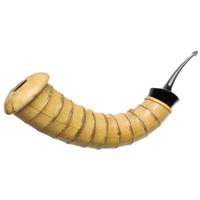
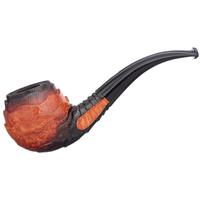
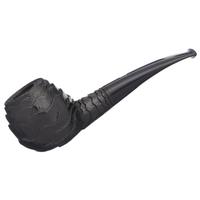
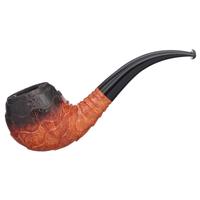
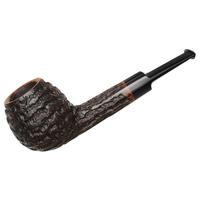
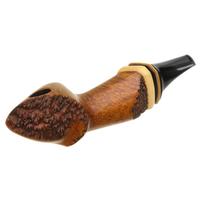
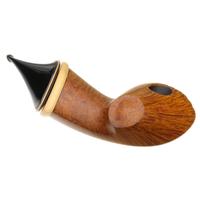
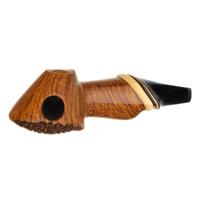
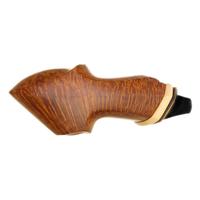
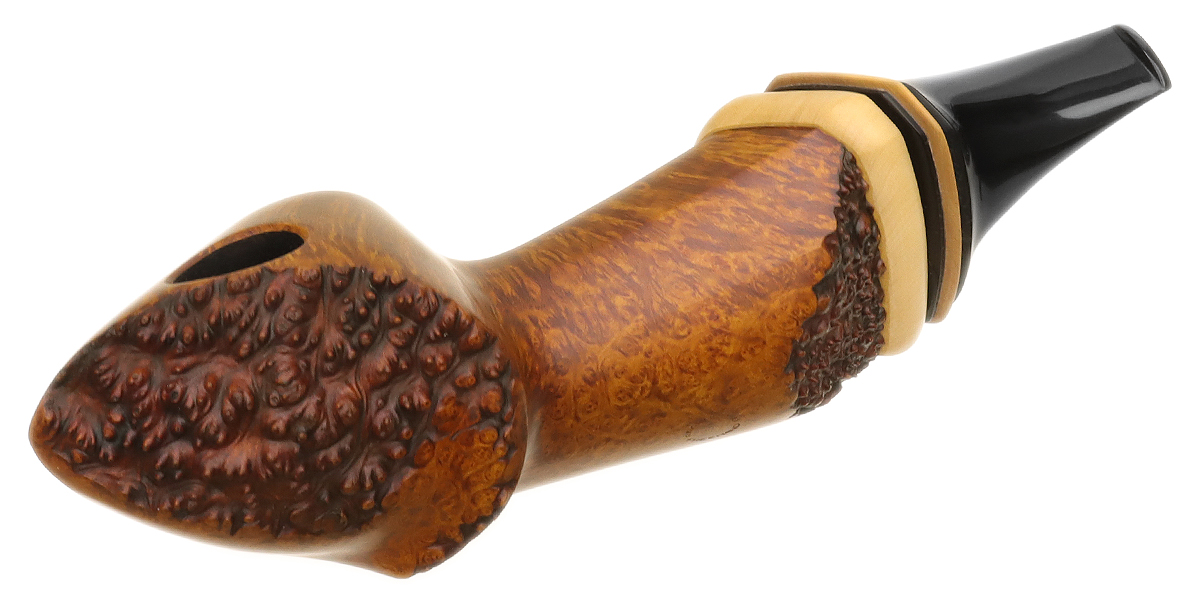
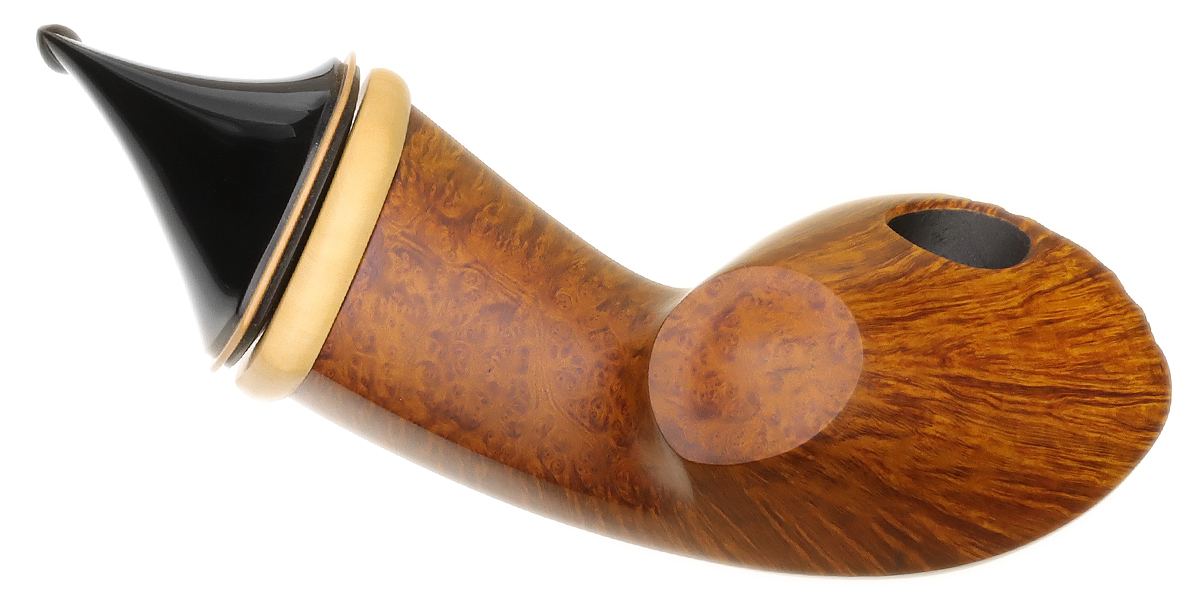
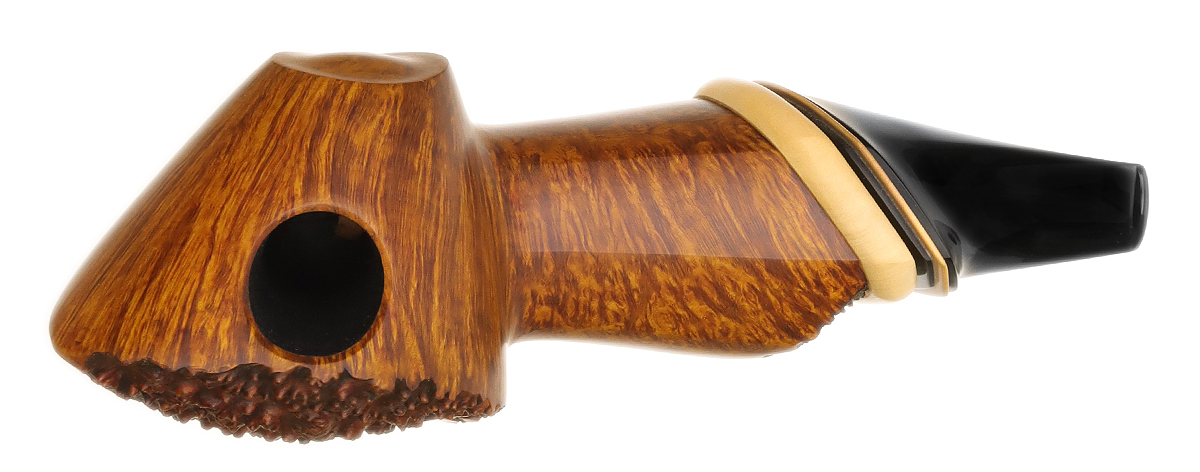
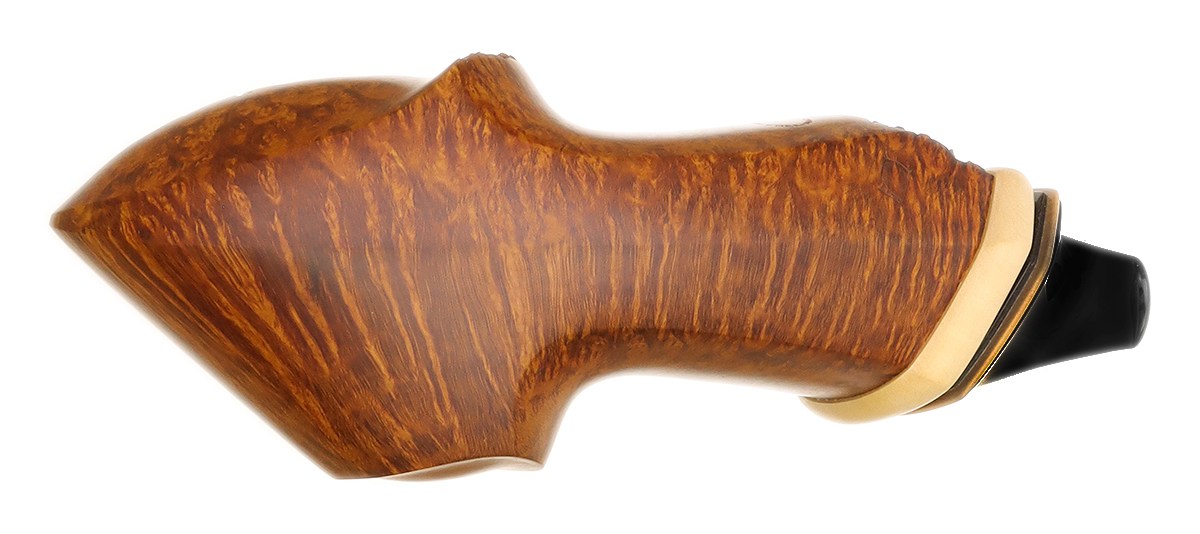
Having earned the elusive "Owl" stamping, Kurusu's highest grade and only the second we've ever seen from him, this Blowfish is a truly exceptional piece which bridges the gap between functional pipe and art piece. This pipe is suffused with an immediately apparent organicism which is tempered by the firm, structural lines that surround certain areas of its build, Ray's style on full display in every part of this pipe. One of Ray's most impressive shaping details is present at the shank end and stem base, comprising a pair of boxwood accents that are shaped to exactly match the outline of their respective points of attachment. The shank's ring is more bulbous compared to the stem's, though the stem's accent is actually inlaid into its black vulcanite and extends outward, creating a rigid line that's prominent both visually and texturally. The stem itself is a broad and thick piece of vulcanite which swiftly tapers toward a small, comfortable button, and it's paired to an equally thick shank that flares out from a wide, sweeping transition, its build marked by a number of ridgelines extending out toward the boxwood accent.
There's an incredible degree of asymmetry present in this piece as a whole, and that's something that its more than seven inches in length and almost half a pound in weight only serve to accentuate, providing an impressively large canvas. The bowl, especially, displays this asymmetry. Though said bowl adheres to the already asymmetric standards of the Blowfish, Kurusu has enhanced the disparity between the panels which frame the flanks here, with a long, continuous taper through the midsection from the right side to the left. What results is a startlingly broad left flank and a comparatively petite right flank, both surrounded by firm panels: the left side's being much more pronounced. At both panels, the lower aft portion is carved in a fin-like curve outward, while the briar that's nearest to the panels has been softly sloped to dip into a gentle outward dome in the middle. While the right side of the stummel is completely smooth, the left has been peppered with a wealth of plateau, the organic peaks peeking out of the shank near the boxwood accent and erupting out of most of the bowl: the bowl's area of plateau having grown in a subtle arc that Kurusu has accounted for with shockingly precise carving. Dressing this pipe is a warm, matte-finished contrast stain that reveals stunning cross grain wrapping around the middle and impressive birdseye on either side of the stummel, no surprise given its grade. This is a pipe that gets more impressive the more you look at it, and full appreciation of its details could easily take hours: bespeaking Ray Kurusu's massive talent.
-John McElheny