

 EN
EN
 JA
JA ZH
ZH





 All New Pipes


















We apologize, but this item is temporarily out of stock. Please check back with us in a few days.

Notify me when this product becomes available!
What's this?
By clicking on the 'Email Me' link you are signing up for a One-Time Alert to be notified when this product's comes back in stock. When the product becomes available, the alerts will be sent in the order in which customers signed up for the alerts. Don't forget: this is a one time alert. Once the product has come back in stock, you'll need to resubscribe for future notifications.
Ask a question about this product.
Measurements & Other Details
- Length: 8.00 in./203.20 mm.
- Weight: 0.64 oz./18.14 g.
- Bowl Height: 1.43 in./36.32 mm.
- Chamber Depth: 1.18 in./29.97 mm.
- Chamber Diameter: 0.67 in./17.02 mm.
- Outside Diameter: 0.92 in./23.37 mm.
- Stem Material: Other
- Filter: None
- Shape: Freehand
- Finish: Carved
- Material: Clay
- Country: Germany
About This Pipe
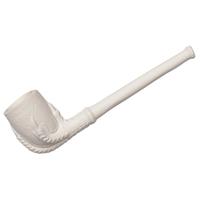
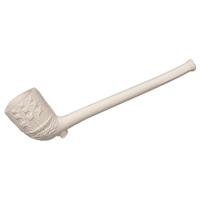
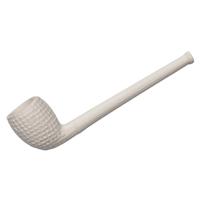
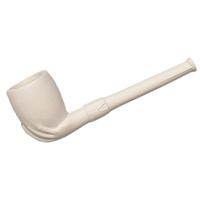
Old German Clay pipes are hand-crafted by Markus Fohr in Montabaur, Germany, using the region's prized white clay. Maintaining his family's rich pipe-making tradition, Fohr utilizes antique hand-presses to mold pipes in the style of centuries past, with some of the presses dating back to the late 18th century. Until briar was popularized in the mid 19th century, clay pipes dominated the pipe-smoking milieu, and for many, they were the only smoking instruments available: Meerschaum pipes existed, but clay was more ubiquitous and economically accessible. Most public houses and taverns provided a communal supply of clay pipes, often in long, willowy Churchwarden form. Today, while briar pipes have become the norm for most pipe smokers, clay pipes are still available and offer a distinct aesthetic and what many consider a neutral flavor. In fact, pipe-tobacco blenders often utilize clay pipes when testing and experimenting with prospective mixtures. Clay is more delicate than other pipe-making materials, so special care is advised when storing and traveling with a clay pipe; however, they're incredibly heat-resistant and immune to burnout, making them perfect workhorse smokers. Even though the bowl will get hot, there's no risk of damaging the pipe — they're fired in a kiln during production, after all.
Offered here is a sleek Bishop and Knight design by Markus Fohr with detailed depictions across the bowl.
Note: While all of our other pipes are photographed individually, these are not, and you may expect some reasonable cosmetic variation between the example we've photographed and the pipe you've received.
Customer Reviews


 0
0
When the pipe arrived, it was well protected, nestled in a cocoon of tightly wound bubble wrapping. Upon releasing it from its sheath, I was surprised to find how small and delicate the pipe was, a drastic difference from the cobs and briars I normally smoke. It felt cool to the touch and porous on the lips. It was at this point I first noticed the potential issues with this stem, so I looked up some simple solutions, prompting me to coat the tip in food grade beeswax until I received some food grade tubing to ease the clench and protect my teeth.
After packing the first bowl, prelighting it, and sipping for the first time, I discovered that clays have the potential to have loose bits of fired clay that could still be resting in the stem or bowl after production. I caught a couple grains, but luckily was able to spit them out. The second thing I discovered was how hot clays burn before they get any type of seasoning. If you are new to clays, do not hold it by the bowl or even the stem down near the bowl. You may be able to do it for a short while, but clays really do become furnaces early on. The third thing I learned is that you have to pack these much less densely than you do with other pipes. None of these are issues though. They are all part of the experience and the learning curve of utilizing this style of pipe.
After you get used to this setup, you get an incredibly clean burning bowl that doesn't alter the flavor of any of the blends you smoke. It smokes cleanly and encourages an even more relaxed and gentle pace than you would use with your cobs or briars. People tend to be fascinated by these pipes, and they always serve as an excellent conversation starter. Beyond that, these pipes, specifically the white ones, serve as an ever evolving vault of memories of past smokes. As the oils and juices burn and settle into the porous clay, it begins to permeate and alter the color and patterning of your pipe. Mine has altered from pristine, porcelain white, to toasty brown, to warm shades of amber. This is only after around twenty bowls, so I am excited to see how it continues changing, especially when it begins to reach the outer surface.
Beyond this, when you reach a color and patterning you like, I have found that you can retain it by applying food grade beeswax to that surface to preserve it.
Due to all these factors, I highly recommend picking up one of these pipes and any of their others that catch your fancy. It has become a regular smoker that you do have to pace yourself with to avoid heat bite with, but because clay doesn't retain ghosted flavors, it can also be smoked back-to-back with completely different blends with minimal issue....Read More
0
0
0
0